
How the Prague Astronomical Clock works
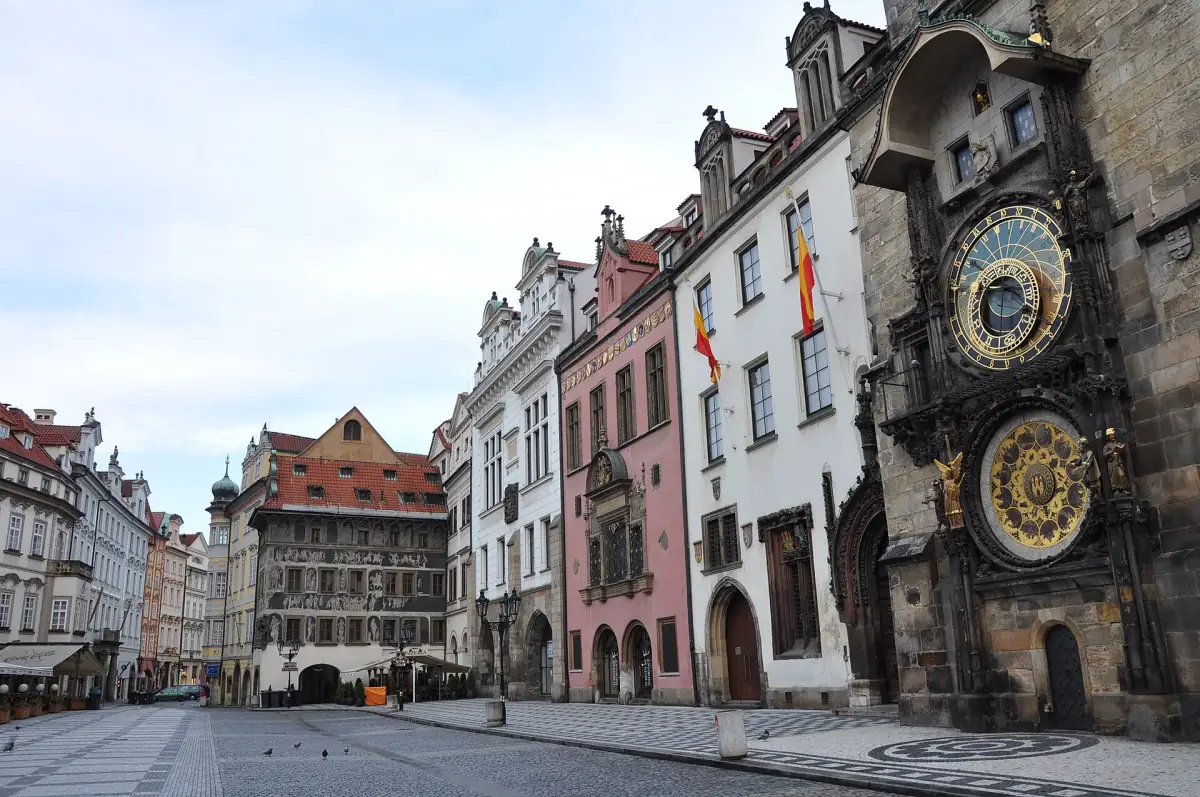
The clock has three main parts. The upper dial is an astrolabe that shows the sun, the moon and the zodiac. The lower dial is a calendar. Above and beside them, figures move on the hour. The clock dates back to 1410, when the clockmaker Mikuláš z Kadaně built it with calculations by Jan Šindel.
It looks like one clock, but it shows several kinds of time at once. That is why the dial can look confusing. Once you know which ring answers which question, it becomes a puzzle you can read. If you want to see the interior of the hall as well, the Old Town Hall tours add the chapel and the basement.
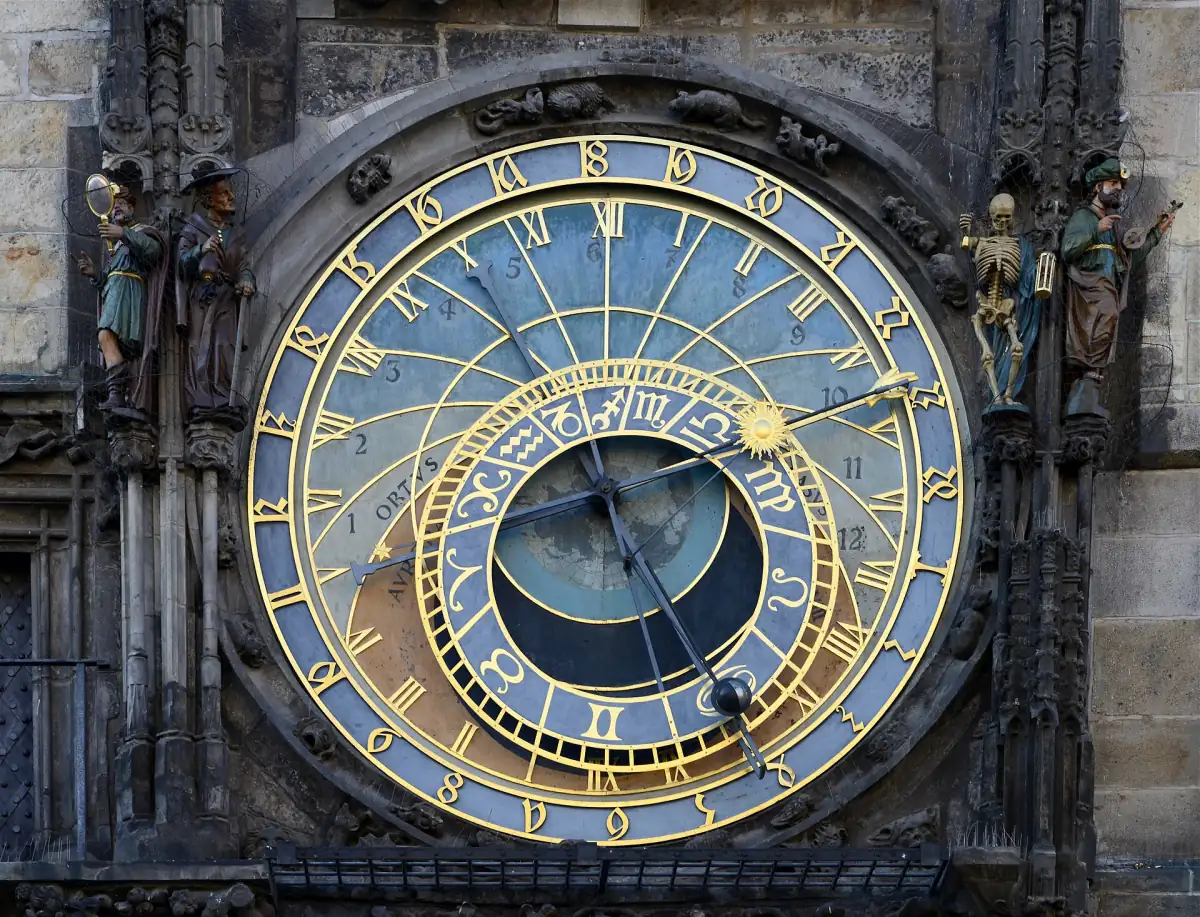
The upper dial: an astrolabe
A model of the sky as seen from Earth.
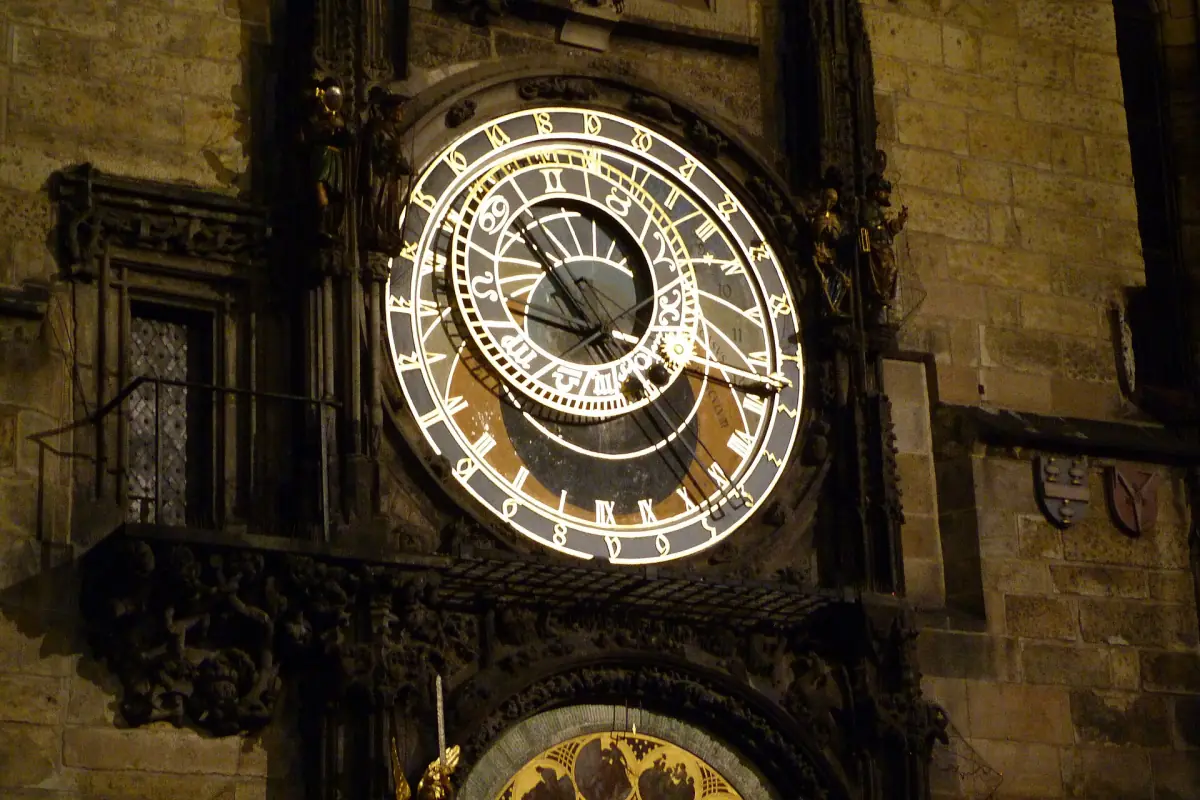
The upper dial is a geocentric astrolabe. The Earth sits at the centre. Around it the dial shows the position of the sun and the moon against the zodiac, with scales for the hours. The background colours show the sky. Blue means day, reddish bands mean twilight and black means night.
| Part of the dial | What it shows | How to read it |
|---|---|---|
| Roman numerals and the golden hand | Time as Central European time is labelled | Follow the tip of the golden hand to the Roman numeral |
| Outer ring of Gothic numerals | Old Bohemian time | The day starts at sunset in this system |
| Babylonian hours | 12 daylight hours between sunrise and sunset | The hours get longer in summer and shorter in winter |
| Star pointer | Sidereal time | Measures time by the stars, not by the sun |
| Moon sphere | Phase of the moon | A two-coloured ball turns to show how much of the moon is lit |
For most visitors, the golden hand against the Roman numerals is enough to start. Add the blue, reddish and black bands to see whether it is day, twilight or night. Do not rely on the clock to set your phone. The scales are a historic display and will not match your watch to the minute.
Our pick: the dials explained on a walk
Our take: a guide explains the dials in front of the clock.
Hand-picked tours, booked through GetYourGuide. Prices are indicative starting prices in euros (as of October 2026). Tap a tour for live availability and the current price in your currency.
Old Town tours and tickets for the clock
Walks, cellar tours and day trips from the Old Town, with live prices and availability.
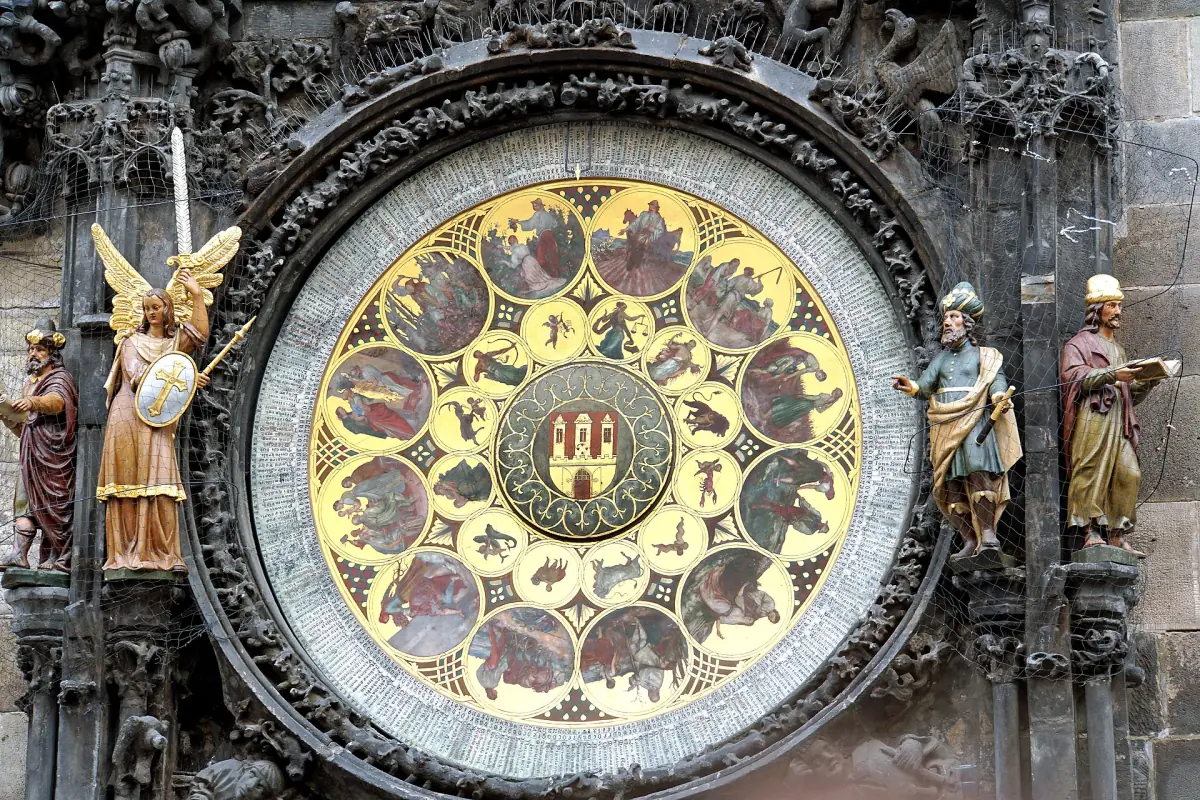
The lower dial: the calendar
Months, zodiac signs and saints' days.
The lower dial is a calendar with a picture for each month, the signs of the zodiac and the days of the saints. The painter Josef Mánes designed the calendar in the 1860s, and the design you see is based on his work of 1866.
What hangs on the wall today is a copy. The original is kept in a museum in Prague. Do not expect to see Mánes's own painting on the facade. Several dates for the copies circulate, so treat any exact year with caution.
The figures and the apostle show
What moves, in what order.
The four moving figures
Death holds an hourglass and rings a bell. The Turk holds a lute. The Miser carries a purse and a stick. Vanity looks into a mirror. The Turk has more than one reading. The idea of excess or indulgence is a traditional allegory, not a statement about people today.
The fixed figures below
Four figures stay still: a philosopher or writer, an astronomer, a chronicler and the archangel Michael. The cock and the apostles are part of the show. Not every figure on the facade is an apostle.
The show in order
On the hour, Death rings and the side figures move. The twelve apostles appear in the windows. Afterwards the cock crows and the clock strikes the hour.
Show times →Repairs and restoration
The clock is serviced regularly. A restoration of eight outer figures has been announced for 2026. Check the current state before you visit. A larger restoration in 2017 and 2018 took the mechanism back to its form of the 19th century.
History of the clock →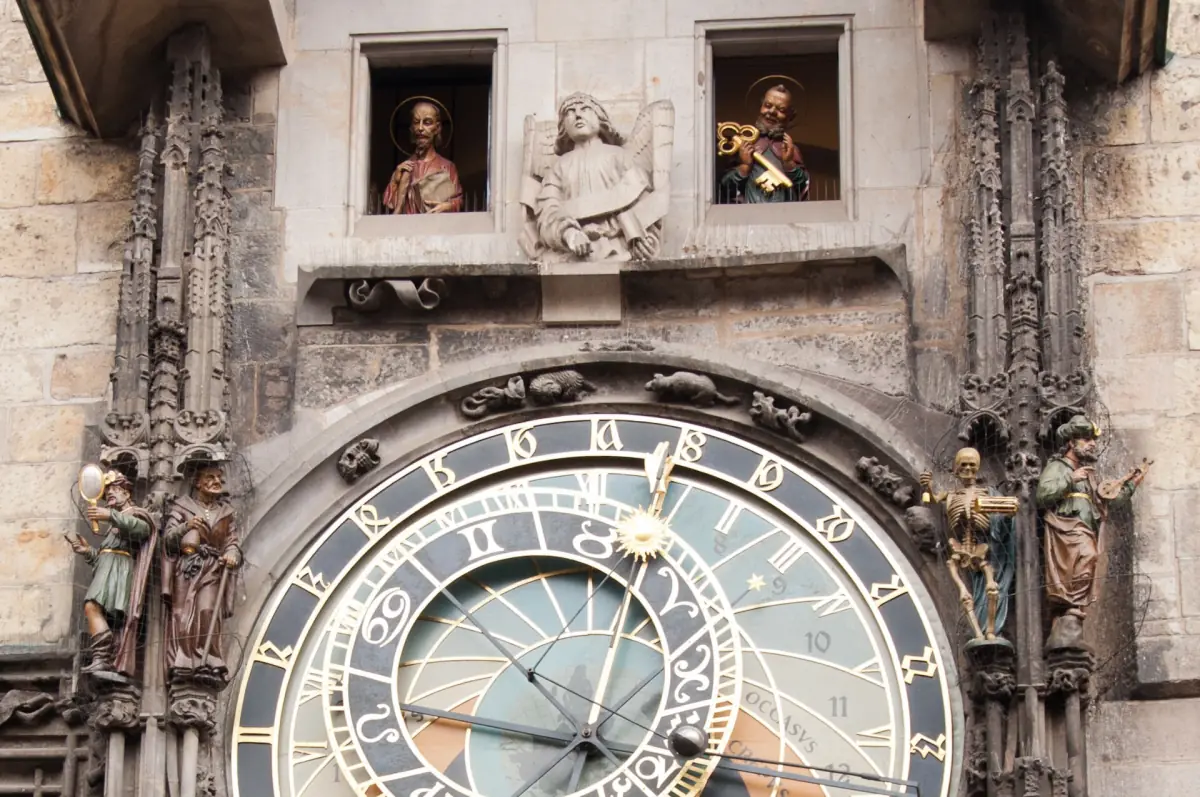
See the mechanism explained
The hall has a digital model.
In the Knights' Hall an interactive digital model of the clock explains the mechanism. It is part of the basic ticket. It is an explanation and not a view of the real works, and it does not replace the clock on the facade.
On the square, arrive a few minutes before the hour to find a place for the show. Come back between shows to look at the dials at your own pace.
How the Prague Astronomical Clock works: frequently asked questions
How do you read the time on the Prague Astronomical Clock?
Look at the golden hand and the Roman numerals for the Central European time shown on the dial. The outer Gothic numerals give Old Bohemian time, which starts the day at sunset.
What do the colours on the dial mean?
Blue marks day, reddish areas mark twilight and black marks night. They show where the sun stands in the sky.
Who built the clock?
The clockmaker Mikuláš z Kadaně built it in 1410, using calculations by Jan Šindel. Master Hanuš worked on the clock later. The story that he was blinded is a legend.
Is the calendar dial original?
No. A copy hangs outside, and the original is in a Prague museum. The design goes back to Josef Mánes in the 1860s.
What are the four moving figures?
Death, the Turk, the Miser and Vanity. They move when the show starts, while the twelve apostles appear in the windows above.
Is this the official website of the Old Town Hall?
No. This is an independent guide. It is not the official website of the city or of the Old Town Hall, and it is not connected to any tour company.